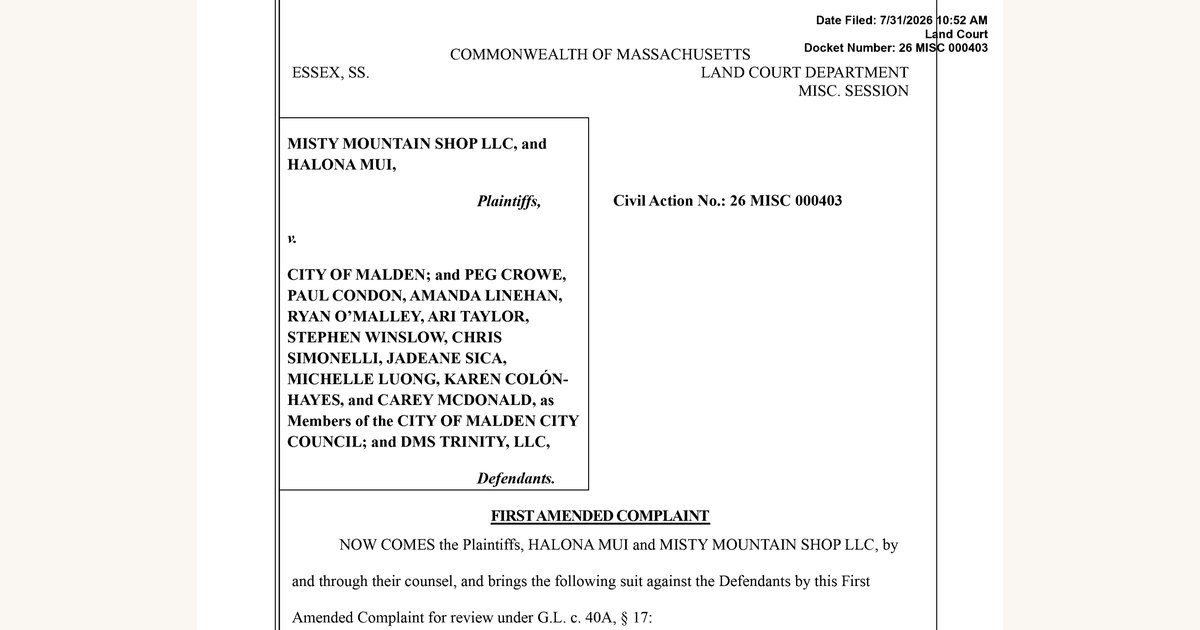
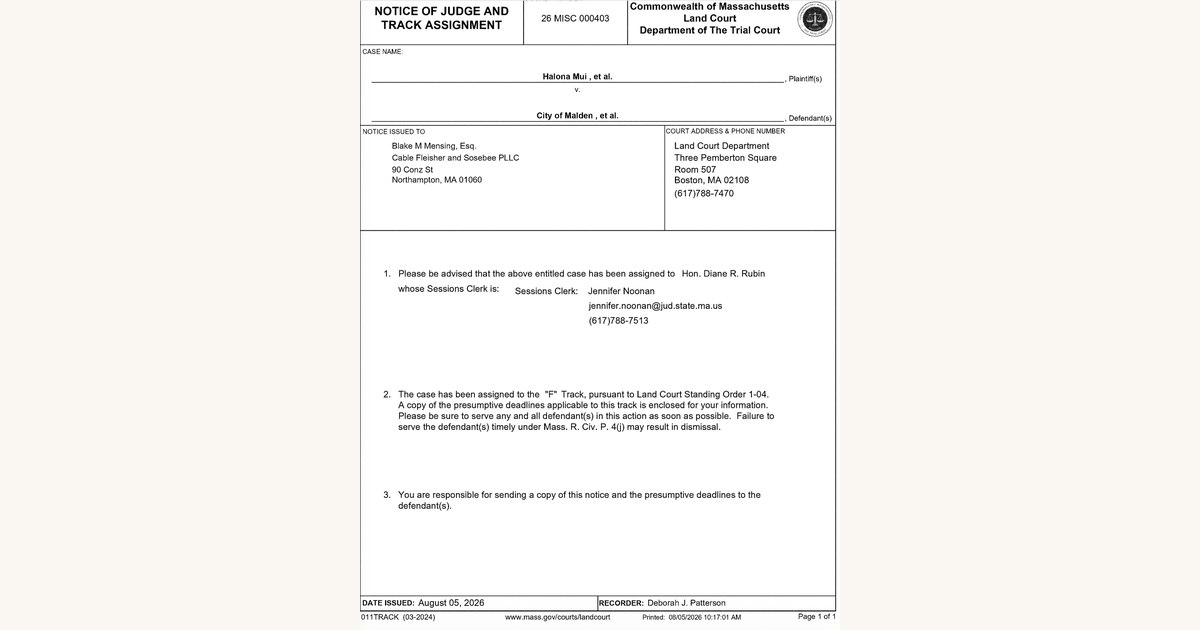
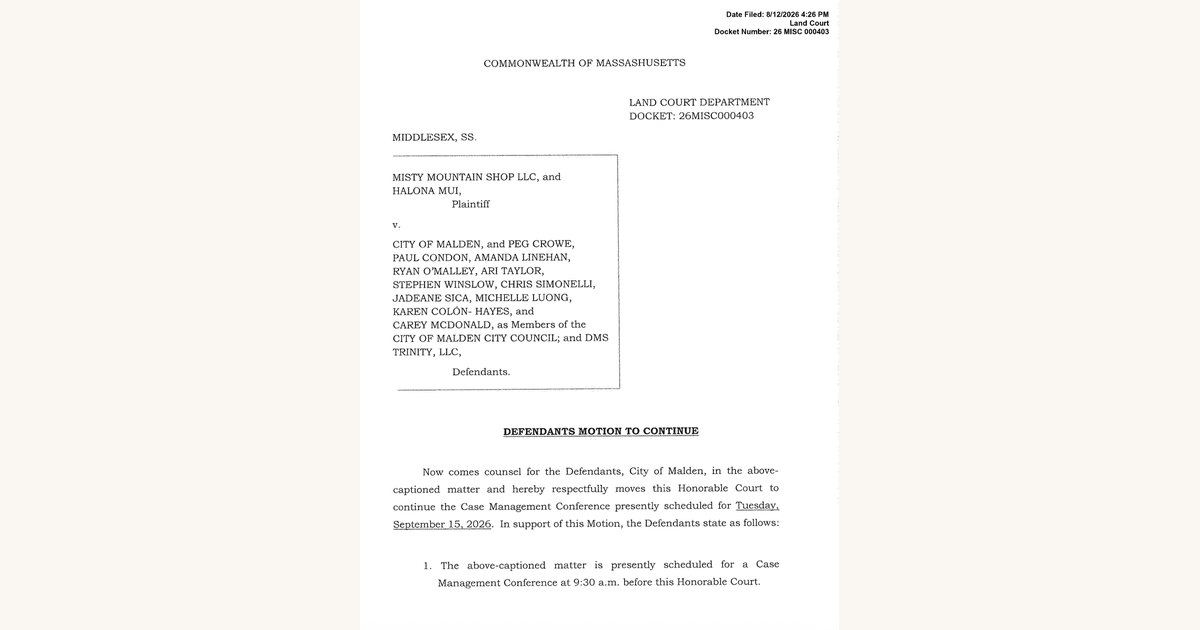
Malden's Legal Department was back in Land Court on September 8, defending itself alongside DMS Trinity, LLC in the lawsuit brought by Misty Mountain Shop LLC and Malden resident Halona Mui over the city's approval of a special permit which would allow a transfer between DMS Trinity, LLC and Beach House Cannabis for a marijuana retail establishment at 36 Charles Street.1
A Civic Broadside reporter monitored the entire hearing live by phone, using the Land Court's public access telephone line. The session ran more than an hour — long enough to surprise multiple people following along.
**A note on sourcing:** the Land Court's public access lines exist for listening only; the Court does not distribute a transcript from them, and unauthorized recording is prohibited. What follows on courtroom exchanges reflects our reporter's contemporaneous notes, confirmed in places against at least one other attendee — not a verbatim transcript. Where we quote the written record instead of the reporter's notes, we say so. Readers should verify current case status directly at masscourts.org, and nothing here should be read as legal advice.

Who else belongs in the case?
Judge Diane Rubin spent part of the hearing asking whether other parties should be brought into the case — specifically Beach House Cannabis and the owner of 36 Charles Street, where a cannabis business is slated to operate. Her inclination, as our reporter heard it, was that both belonged in the case, so they could raise any questions upfront rather than being left with them after decisions were already made.
Much of the rest of the session concentrated on zoning. A fair amount of the discussion worked to clear up confusion that has lingered since Malden's cannabis-specific zoning ordinance, §12.12.190, was struck down as a result of the *Benevolent Botanicals* ruling against the city.2 Discussion centered on non-transferability and on the process for appealing the city's most recent special permit for DMS Trinity, preserved in the case record as Exhibit A.
There was, by our reporter's account, considerable confusion among the parties — and the Court itself — over which Malden ordinances now apply to cannabis companies permitted before the *Benevolent Botanicals* decision. On review, Judge Rubin acknowledged that readers of her clarified judgment, Misty Mountain among them, could reasonably read it differently than the city and DMS Trinity do.
-
View PDF →Malden Zoning Ordinance §12.12.190 — Marijuana Establishment
-
View PDF →Malden Ordinance §6.08.070 — Licensing of Marijuana Establishments
A leak, a timeline, and two concerns from the plaintiffs
At one point, Judge Rubin asked directly whether 36 Charles Street was open for business yet. According to our reporter's notes — again, not a transcript, but confirmed with at least one other attendee — Attorney Roberto DeMarco, who has represented DMS Trinity for several years, told the Court a water leak had caused a delay, and estimated the property would open in two to three months. Judge Rubin also asked about the corporate structure of the business going forward.
The plaintiffs raised two central concerns during the hearing: the parking impact on the surrounding area, voiced by the resident who lives close to 36 Charles Street, and whether Beach House Cannabis will face the same process and scrutiny as an applicant that Misty Mountain itself was held to when it went through licensing.
Please note that you are prohibited from making any unauthorized recording of the court event.
Seven ways forward
In a highly interactive discussion with counsel for both sides, Judge Rubin walked through — by our reporter's count — seven options for how the case, and the underlying zoning confusion, might be resolved:
- A stipulation among the parties as to which ordinances Malden will follow going forward.
- An Amended Complaint #2, adding Beach House Cannabis and the 36 Charles Street property owner as defendants.
- A CLEC (Cannabis Licensing and Enforcement Commission) review of Beach House Cannabis as a proposed licensee, to be formally vetted.
- The parties entering mediation, as a form of Alternative Dispute Resolution.
- A remand from Judge Rubin to the City Council, to help clean up the ordinance situation and directly address the non-transferability questions around cannabis zoning, special permitting, CLEC licensing, and Host Community Agreement procedures.
- A clarified judgment from Judge Rubin further explaining the earlier *Benevolent Botanicals* ruling — which would require notice and a hearing with Benevolent Botanicals, and raises an open question about whether it would trigger a new appeals period.
- A Discovery schedule, anticipated to run through March 2027 — setting in motion roughly a full year of continued litigation.
Where it stands
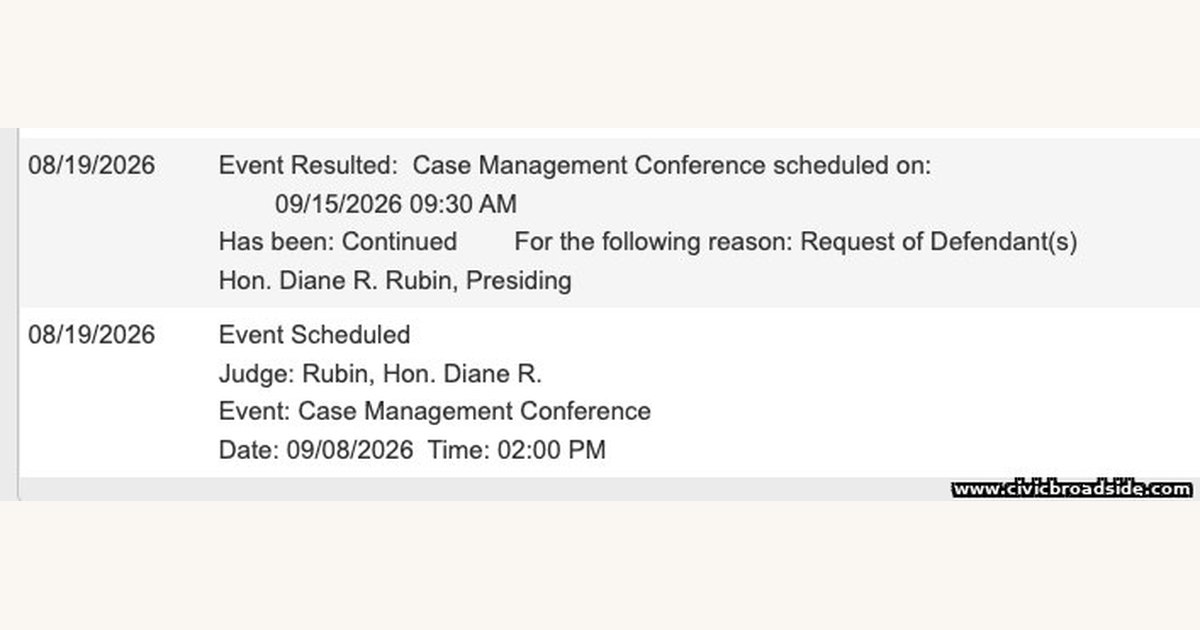
By the end of the September 8 hearing, Judge Rubin seemed convinced that the existing confusion around non-transferability is a real roadblock the court and parties will have to reckon with. She offered the parties a chance to say how they'd like to proceed. In the end, the Court agreed to return by Zoom on Wednesday, September 23, at 2:30 p.m., giving each side time to weigh the options — and their consequences — beforehand.
Just before the public phone lines went silent, our reporter noted a moment of reflection from the bench on how messy the case has become with confusion among the parties. The following day, September 9, the Court's public docket was updated with its own memorandum of the hearing — included among the documents below.
The docket record


-
View PDF →Land Court docket entry, September 9, 2026
-
View PDF →Exhibit A — Notice of Decision, Case 334-26