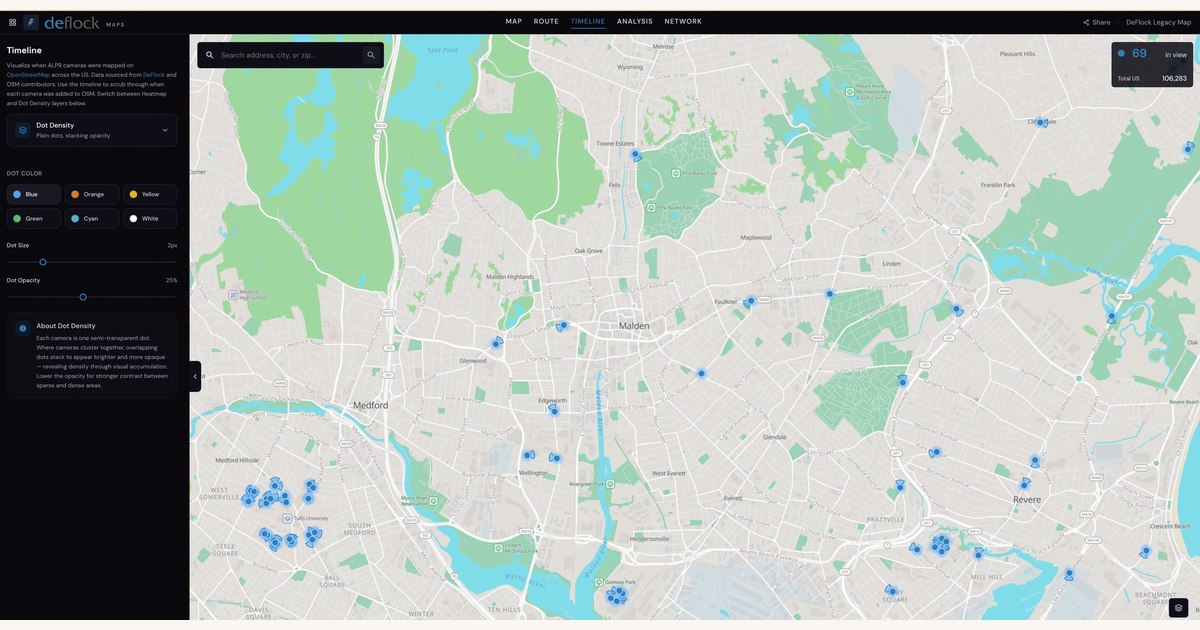
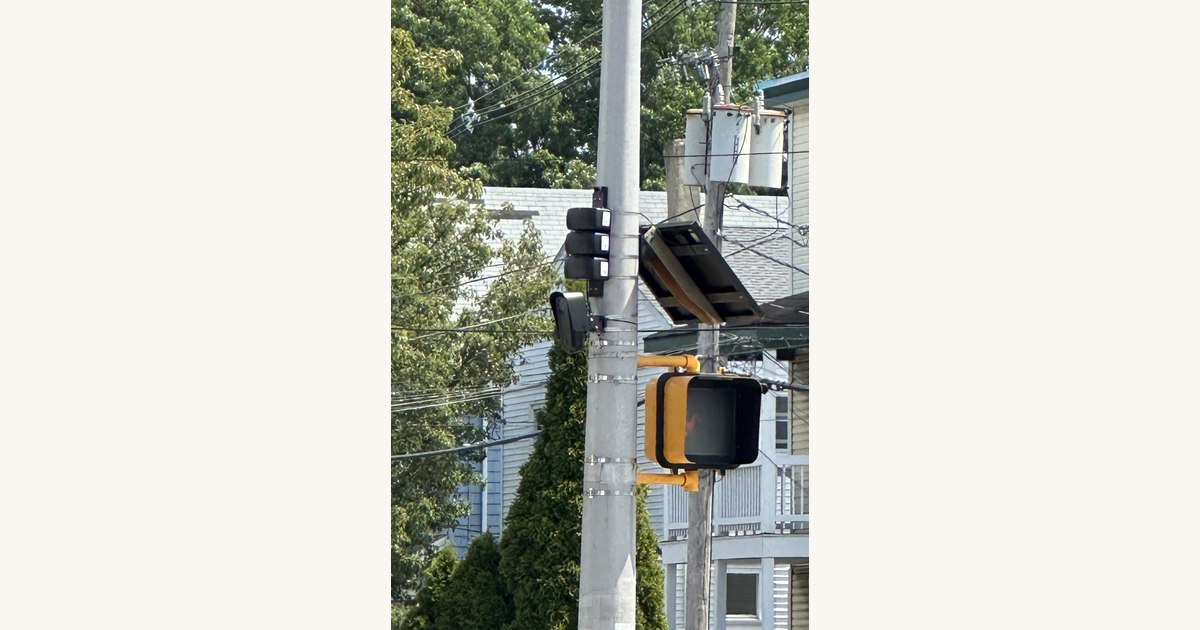
Boston.com's Samantha Genzer reported this week that Lowell and Methuen are both taking a fresh look at their use of Flock Safety's license-plate reader cameras.1 As part of that story, Lowell Police revealed its own Flock transparency portal2 — the same style of public data page Malden has been running.
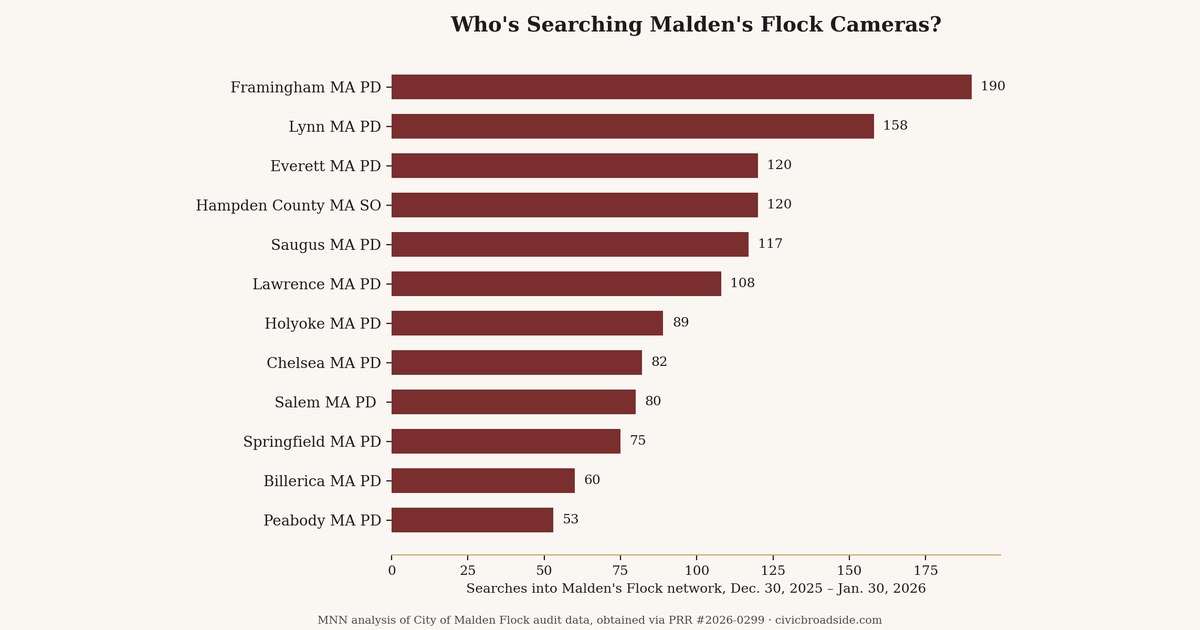
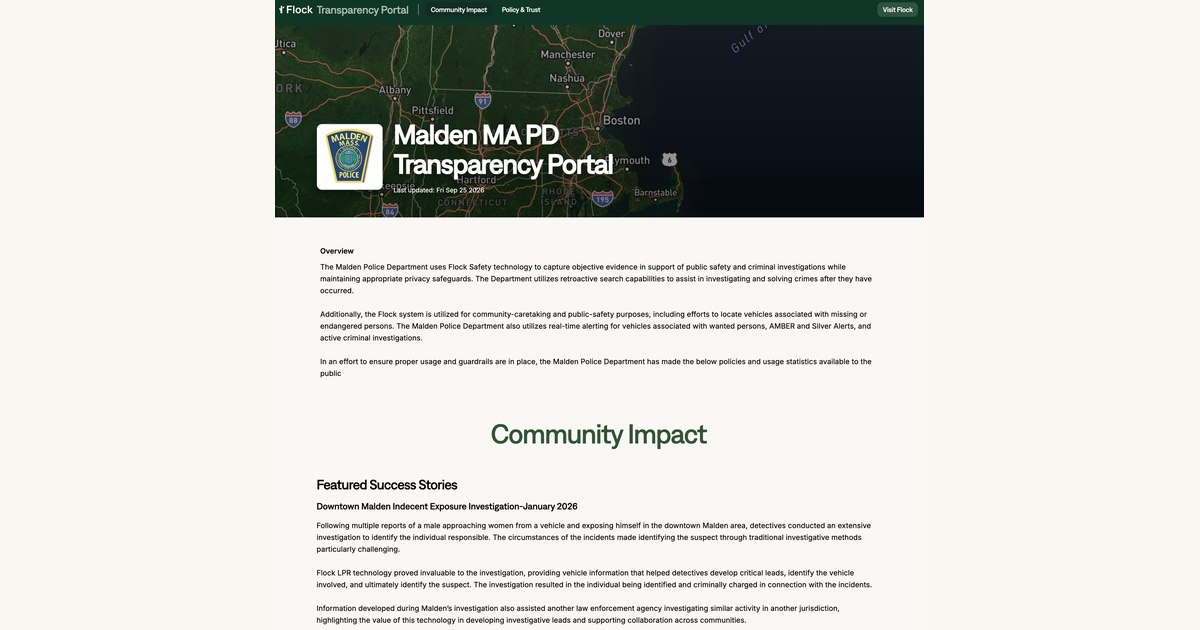
We went back for a closer look at Malden's transparency portal3 — specifically, who the Malden Police Department is sharing its camera data with, and how that list has changed in just the last few days.


Four Fewer Organizations, Zero New Ones
We pulled the full list of outside organizations named as having access to Malden's Flock data and compared them as complete sets. (The comparison was not by row position — the two columns on the portal's export don't line up one-to-one, so a side-by-side row comparison would have produced a misleading result.)
Over those three days, zero organizations were added to Malden's sharing list. Four were removed: Grafton, Milton, Tewksbury, and Weymouth police departments. Every other organization from the 9/22 list — 94 of them, mostly other Massachusetts municipal police departments, plus two sheriff's offices, the state Department of Correction, a regional dispatch center, and one campus police department — was still listed on 9/25.
| Organization | Status |
|---|---|
| Grafton MA PD | Removed |
| Milton MA PD | Removed |
| Tewksbury MA PD | Removed |
| Weymouth MA PD | Removed |
| 94 other organizations | Unchanged |

Malden's Own Numbers Shifted, Too
The portal doesn't just list who Malden shares with — it also publishes a running usage summary for Malden's own 12 cameras. That didn't hold steady either. Over the same three days, unique vehicle detections in the trailing 30-day window dropped from 312,452 to 291,049, down about 6.9%. Hotlist hits fell a similar share, from 2,322 to 2,152. Search sessions moved the other direction, up from 75 to 84. Camera count (12) and the 7-day data retention window were unchanged on both dates.
We don't read too much into a single 30-day rolling window moving a few percentage points in either direction — some of that is normal noise. It's the org-list change, which is a discrete yes/no per organization rather than a rolling average, that's harder to wave off as noise.
What We Know About the Four Departments Removed
We don't yet know why Malden's list changed. Flock's own materials describe sharing relationships as something the data owner — in this case, Malden — configures and can revoke at any time, though the exact mechanics of who can end a relationship from the other side aren't fully documented in what we've found so far.4 It could be a decision on Malden's end, a decision by one of the four departments, a lapsed agreement, or something else.
What public reporting does tell us is that the four departments aren't all in the same place with Flock right now:
- Grafton PD: Deactivated all 12 of its Flock cameras in late August, citing community concerns along with vandalism and theft of the devices.5
- Weymouth PD: Reported running roughly 34 active Flock cameras as of late August — the most recent figure we could find.6
- Milton PD: A public-records response cited 13 active cameras and a Flock contract running through March 2028; we found no report of that changing since.7
- Tewksbury PD: Under a formal Select Board review of its Flock contract, with special counsel evaluating the agreement as of early August; we found no report that the review has concluded.8
In other words, only one of the four — Grafton — has a documented, public reason to have dropped off Malden's list: it no longer has an active camera network to share in the first place. We didn't find reports of the other three pausing or ending their own Flock use, which means either that a decision hasn't been made public yet, or something else explains why Malden stopped sharing with them specifically.
The Bigger Picture
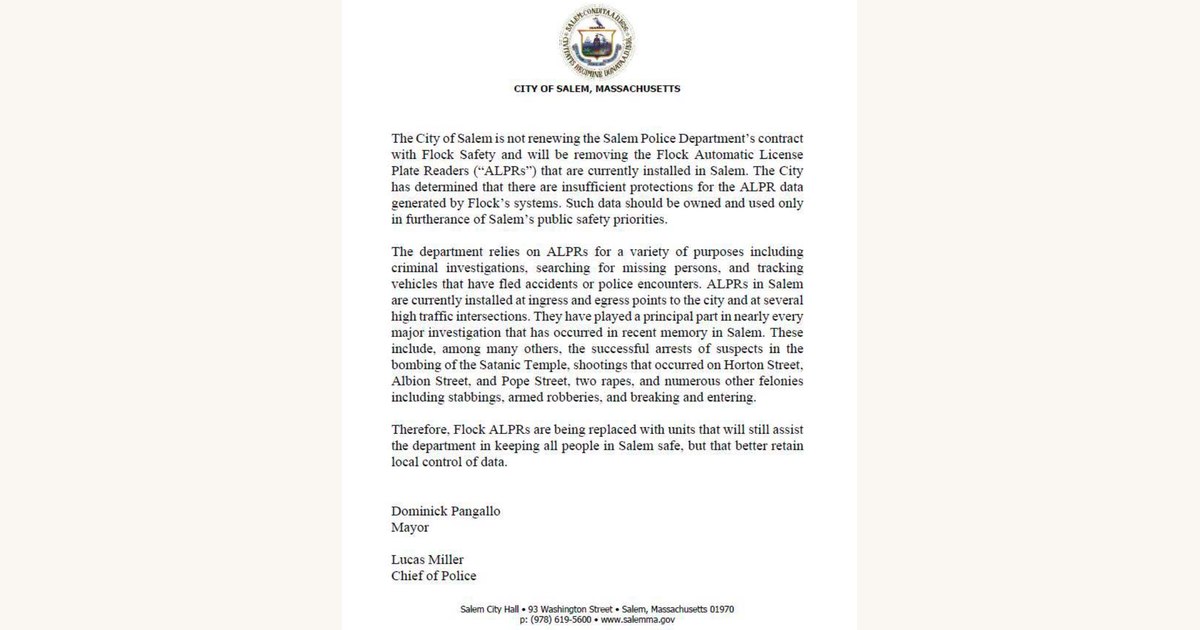
None of this is happening in isolation. A wave of Massachusetts communities has been reconsidering Flock contracts through the second half of 2026, and Boston.com's own statewide tracker shows a growing list of cities and towns that have ended, paused, or are actively reviewing the technology.9 Lowell and Methuen's moves this week are the latest additions to that list — and Malden's quietly-shrinking sharing network may turn out to be part of the same story, or may turn out to be unrelated administrative housekeeping. We don't know yet.
In the near future, people might start asking about the "MBTA Bus Stop and Bus Lane Automated Camera Enforcement Program" beginning October 1, 2026. This Automated Camera Enforcement Program should help clear the bus lanes and bus stops but could also raise privacy and data management issues we've heard with Flock ALPRs.
Mass. General Laws c. 90K covers Automated enforcement of bus stop and bus lanes This was enacted via St. 2024, c. 363 (effective April 8, 2025).
-
View source →Lowell, Methuen suspend use of Flock cameras — Boston.com, Sept. 24, 2026
-
View source →Malden MA PD Flock Safety Transparency Portal
-
View source →Lowell MA PD Flock Safety Transparency Portal
-
View source →Two more Mass. communities cancel Flock cameras — The Boston Globe, Aug. 22, 2026
-
View source →East Bridgewater Pulls Plug on Flock Cameras After Resident Backlash — Hoodline, Aug. 21, 2026
-
View source →Community concerned over Flock cameras — The Milton Times
-
View source →Tewksbury Select Board update on Flock Safety contract review — Tewksbury Town Crier
-
View source →Where Mass. cities and towns stand on Flock cameras — Boston.com, Sept. 13, 2026
-
View source →Does Flock share data with ICE or federal agencies? — Flock Safety